
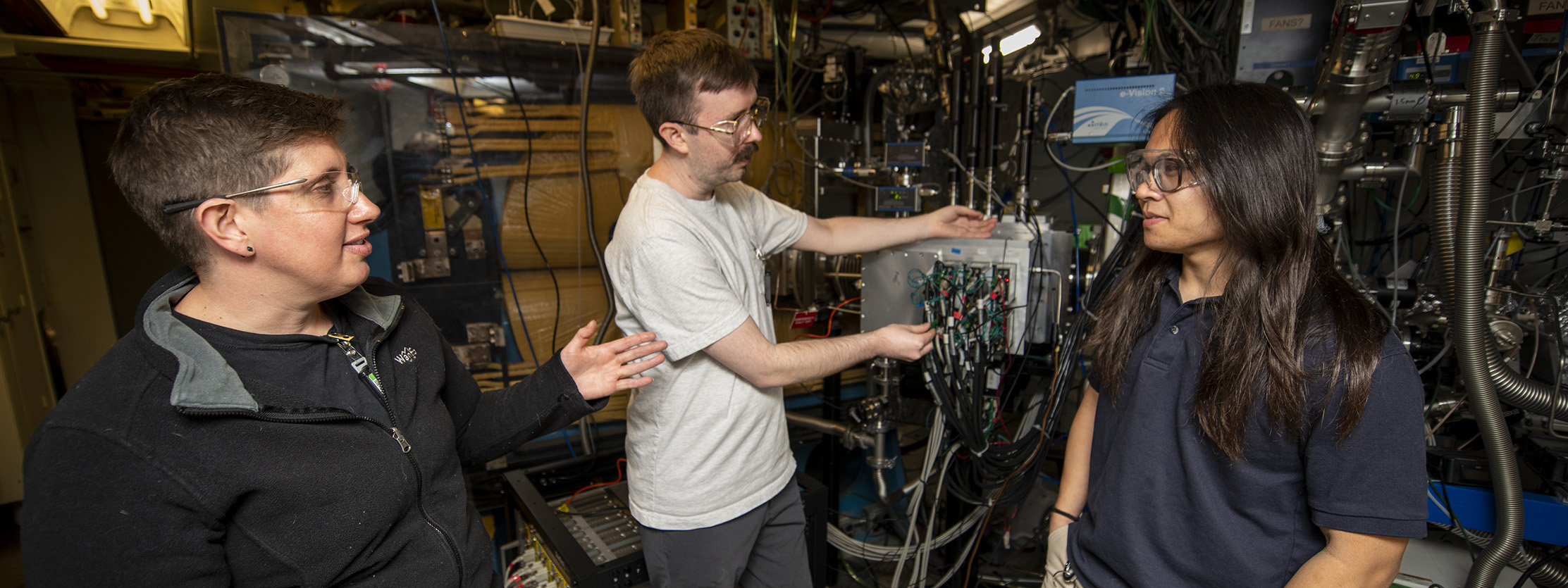
In collaboration with partners both within and outside Berkeley Lab, we strive for equal access to cutting-edge, research based, scientific careers for students and postdocs from diverse backgrounds. Additionally, we foster national security literacy through innovative educational initiatives. Our mission is to inspire and equip the next generation of scientists for impactful careers in service of the nation.

NextGen Nonproliferation Leadership Development Program
The Next-Generation Leadership Development Program (NextGen) expands and strengthens the early career pipeline of the nonproliferation R&D community by accelerating the development of the next generation of leaders committed to driving the mission forward. NextGen merges advanced science and technology with top-notch research facilities, emphasizing nonproliferation by collaborating with other NNSA Nonproliferation Stewardship Program (NSP) initiatives and DNN R&D projects. It also includes comprehensive career development, leadership training, and nonproliferation education. NextGen leverages DNN R&D university consortia, Berkeley Lab postdoc and early career programs, and a tailored national lab system, all with a focus on nonproliferation and leadership development.
NSSC
The Nuclear Science and Security Consortium (NSSC) is a multi-institution initiative established by the National Nuclear Security Administration (NNSA) to train the next generation of nuclear security experts while engaging in research and development in collaboration with U.S. DOE National Laboratories in support of the nation’s nonproliferation mission. Originally established in 2011, with successful re-competitions in 2016, 2021, and 2026, the consortium, led by the University of California, Berkeley, is currently comprised of eleven universities and is in cooperation with five national laboratories.

ETI 2.0
The mission of this Consortium is to guide a multidisciplinary research and education environment that supports cross-cutting, collaborative technologies across three core disciplines: data science and digital technologies for nuclear security and nonproliferation; precision environmental analysis for enhanced nuclear nonproliferation vigilance and emergency response; and emerging technologies. The ETI is composed of twelve higher education institutions and twelve national laboratories.

CNF
The Consortium for Nuclear Forensics (CNF) is a University of Florida-led consortium sponsored by the National Nuclear Security Administration (NNSA). The CNF comprises 17 Universities and 7 National Laboratories that contribute to important research fields within nuclear forensics. This will be achieved by focusing on five main research areas: Rapid Turnaround Forensics, Advanced Analytical Methods, Ultrasensitive Measurement, Signature Discovery, and Prompt Effects which will be achieved by using the combined expertise in radiochemistry, geochemistry, analytical chemistry, nuclear material science, shock physics, quantum-enabling sensing, high-performance computing (HPC)/data science, and training and education.
DNN Tech
To advance U.S. national security and prevent nuclear proliferation, the NNSA’s Office of Defense Nuclear Nonproliferation (DNN) established the Enabling Capabilities in Technology (TECH) consortium. DNN TECH focuses on developing critical scientific knowledge and innovative capabilities while building a pipeline of skilled professionals for DOE National Laboratories through joint mentorship, diverse research, and specialized training. This consortium is made up of 15 higher education institutions and eight national laboratories.
NNSA-IMPACT National Nuclear Security Administration Impact Internship Program
The NNSA Impact Internship Program (NNSA-IMPACT) provides fully funded summer internships at Berkeley Lab for undergraduate and graduate students. Designed to develop the next generation of professionals, the program offers hands-on experience with unique NNSA mission challenges across various STEM and complementary disciplines.
Minority Serving Institution Partnership Program (MSIPP)
ONHS has developed strategic partnerships to provide research opportunities with Minority Serving Institutions (MSIs). The mission of the Minority Serving Institution Partnership Program (MSIPP) is to create and support a sustainable career pathway that prepares a diverse workforce of talented students to make immediate and significant contributions to the Nuclear Security Enterprise (NSE).
